통합 검색
통합 검색
Exhibitions
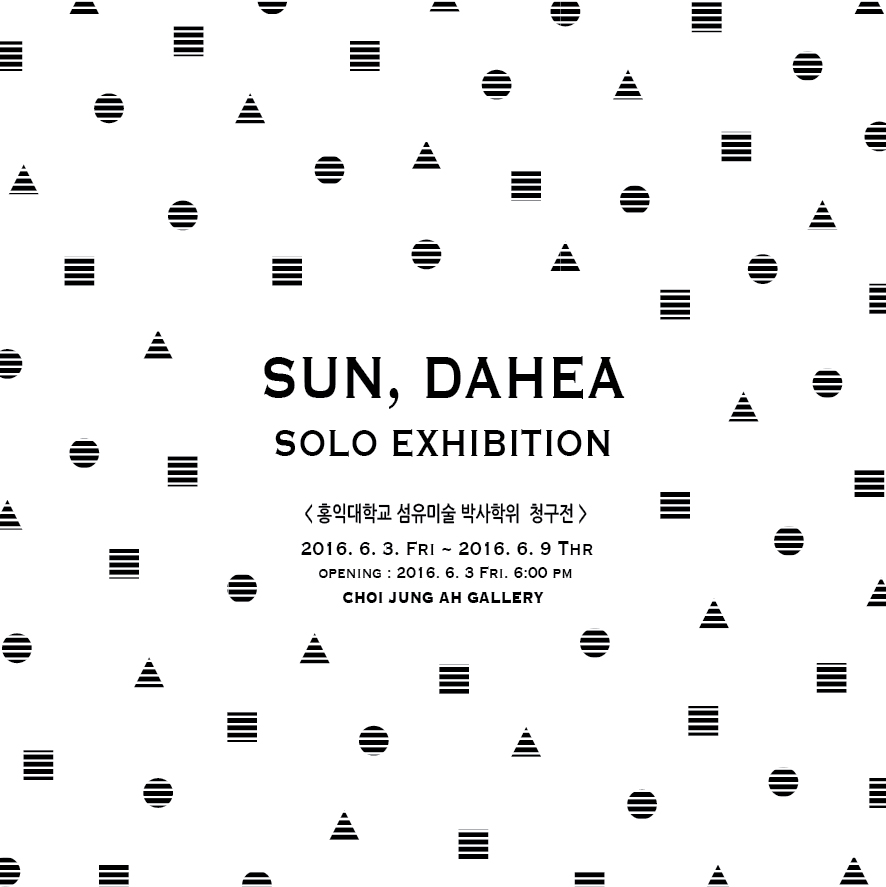
SUN, DAHEA
2016.6.3 ~ 2016.6.9
CHOI JUNG AH Gallery
Hongmoonkwan, Hongik Univ., 72-1, Sangsu-dong, Mapogu, Seoul
Topological Structure of a Delicate Sense
< Diversity is virtually an actual image and should be addressed as a mani- fold. Only then it does not enter into relationships with “one” as a subject or object, natural or spiritual reality, an image, and world. Manifolds of rhizome appearance debunk fake manifolds of tree shapes. Here, there is no unity that serves as the main axis within objects or unity divided within subjects. There is no unity that is inherited within objects or “returns” to subjects. Manifolds do not have any subject or object. Manifolds can only have rules, sizes, and dimensions. And these things can be increased only when the nature of manifolds changes. > Gilles Deleuze/Felix Guattari, 『A Thousand Plateaus: Capitalism and Schizophrenia』
Dahea Sun is interested in various materials constituting fiber and creates units constituting fabric by discovering fabrics that have already been pro- duced and using them as the fibers of thread. She combines these fabrics, which constitute the surface, and modifies the surface shape to produce her work. Finding materials ranging from traditional ones commonly found in our surrounding (such as silk, organza, wool, leather, polyester, beads, brass mesh, and stainless steel) to novel materials is the beginning of her work.
Just as another artist might choose colors, mix them on a palette, and then paint, she discovers and interweaves things in this world with her excep- tional visual and tactile sense. The materials she selects have various soft properties such as delicacy, softness, flexibility, hardness, gloss, and elasticity. Their weave is an areolar structure with gaps. The soft and thin mesh shape is reminiscent of objects ranging from the natural, such as drag- onfly wings, veins of plants, and crust of skin, to urban civilization objects such as mesh, graph paper, roads viewed from the sky, building windows, and lights. The raw materials consisting of these strips are very beautiful in themselves. Dahea Sun is interested in basic figures that are necessarily connected to these materials and repeatedly creates many three-dimensional structures of circles, triangles, and rectangles in advance. She closes the seam by cutting strips in appropriate sizes and assigns an artistic position to the units themselves by applying various craft techniques such as embroi- dery, knitting, and printing.
Since the units essentially have transparent elements, as a universal and objective system, they soak their way into the senses that we already have experienced and give a smooth aesthetic affinity. Like the cells of living organisms, one unit attaches to the other unit of the same form and they become a textile fabric. Then, the fabric becomes the surface of everyday objects and a work of art. She has produced small- and large-sized fabrics by repeatedly attaching the units and has utilized them in various genres including fine art, craft, design, fashion, and architecture, depending on context. Her small and tender pieces are used as ornaments such as brooches; her large artworks become paintings and sculpture works by contact with the appropriate surface of places, such as the surface of an indoor wall, ceil- ings, and pillars. Sometimes they coat the surface of interior accessories such as lights and chairs and thereby provide a unique new environment. Thus, diverse modulations applied to everyday objects or architecture have the ad- vantage of being applicable across all genres of art through their sensual intimacy of touch and sight.
The network structures of the unit and empty unit parts in the Tube Series she has recently produced vitalize the artwork as it breathes by blurredly effusing dark color and make it communicate with the surrounding. The repeti- tive form of the network structures stacked in layers exudes color and forms a gray translucent haze zone. The life of a woman who changes the environment vibrantly and beautifully by quietly being patient and applying her efforts despite her frail body is reflected in her artwork. The lyrical sensibility in this soft and comfortable artwork embracing its surroundings immerses us into a poetic world.
Like living creatures, her artwork becomes horizontal or droops depending on the nails by which it is hung; thus, it changes into other forms continuously and generates an organic flow. It is different from the conventional art- works that are determined by the environment, require a separate place, and have a vertical authority and aura. This is the rhizome that adapts to the environment by breathing and entering into relations with its surrounding, as plants do.
Since Tube Series by Dahea Sun has a topological structure of a monochromatic tone, it is in the form of efficient information dissipation; thus, this fits well with contemporary tastes. The repetition of units with infinite poten- tial for change and communication unfolds a feast of delicate and sophisti- cated senses by spreading out horizontally and radially.
KIM Mi Jin
( Professor of the Graduate School of Hongik University, critic & curator )


